
Delaware raised the flat annual tax that every Delaware LLC pays from $300 to $400, and a large share of the comparison pages a founder reads in 2026 still print the old number. The change sits in House Bill 400, approved on May 21, 2026, and its timing is stranger than the increase itself: the new rate applies to tax year 2026, yet the first $400 payment is not due until June 1, 2027. What follows is what changed, what $100 a year does to the Delaware vs Wyoming math, and which date belongs on your calendar.
What HB 400 changed
House Bill 400 became Chapter 273 of the Laws of Delaware, Volume 85. Section 23 of the act rewrote 6 Del. C. § 18-1107(b) so that every domestic limited liability company, and every foreign LLC registered to do business in Delaware, pays an annual tax of $400, up from $300. Each registered series of a Delaware LLC now pays $100 a year, up from $75. Sections 9 and 16 of the same act raised the annual tax on limited partnerships and on partnerships to $400 as well, so the increase covers Delaware's alternative entities as a class, not just LLCs.
Searchers often call this charge the Delaware LLC franchise tax. The statute calls it an annual tax, and unlike a Delaware corporation, an LLC files no annual report alongside it: the payment is the whole recurring state obligation. It is also flat. A dormant holding company and an operating business with real revenue owe the same $400, because the tax does not scale with income, assets or activity.
The effective dates are the real story
Section 45 of the act splits the start dates. Sections 9, 16 and 23, the three annual tax sections, took effect on January 1, 2026. The act's long list of filing fee increases took effect later, on August 1, 2026. The split matters because 6 Del. C. § 18-1107(c) makes each year's tax payable on the first day of June following the close of that calendar year. The payment collected on June 1, 2026 was therefore still $300, settling tax year 2025. Tax year 2026 is the first year billed at $400, and that payment falls due on June 1, 2027.
Delaware does not prorate this tax. The Division of Corporations assesses it on an entity that is active at any point during the calendar year, so an LLC formed on December 28, 2026 owes the same full $400 for 2026 as one formed on January 2. Founders forming in the last quarter of 2026 are the first cohort whose entire first tax year bills at the new rate, and anyone budgeting from a guide written before the act passed is budgeting $100 a year too low.
What $100 a year does to the three-state math
The Total Cost Calculator on this site totals a jurisdiction the simple way: the recorded setup cost plus three years of the recorded annual government fee. Setup cost in the IncorporateCompare dataset means the minimum realistic total first-year setup, government filing fees plus the cheapest reputable formation-service package, not the filing fee alone. Registered agent fees are not recorded in the dataset, so they are not inside these totals. Every figure in the table comes from the dataset's 50-jurisdiction file, verified on September 13, 2026.
| Jurisdiction | Recorded setup cost | Recorded annual government fee | 3-year total |
|---|---|---|---|
| Delaware LLC | $110 | $400 | $1,310 |
| Wyoming LLC | $100 | $60 | $280 |
| New Mexico LLC | $50 | $0 | $50 |
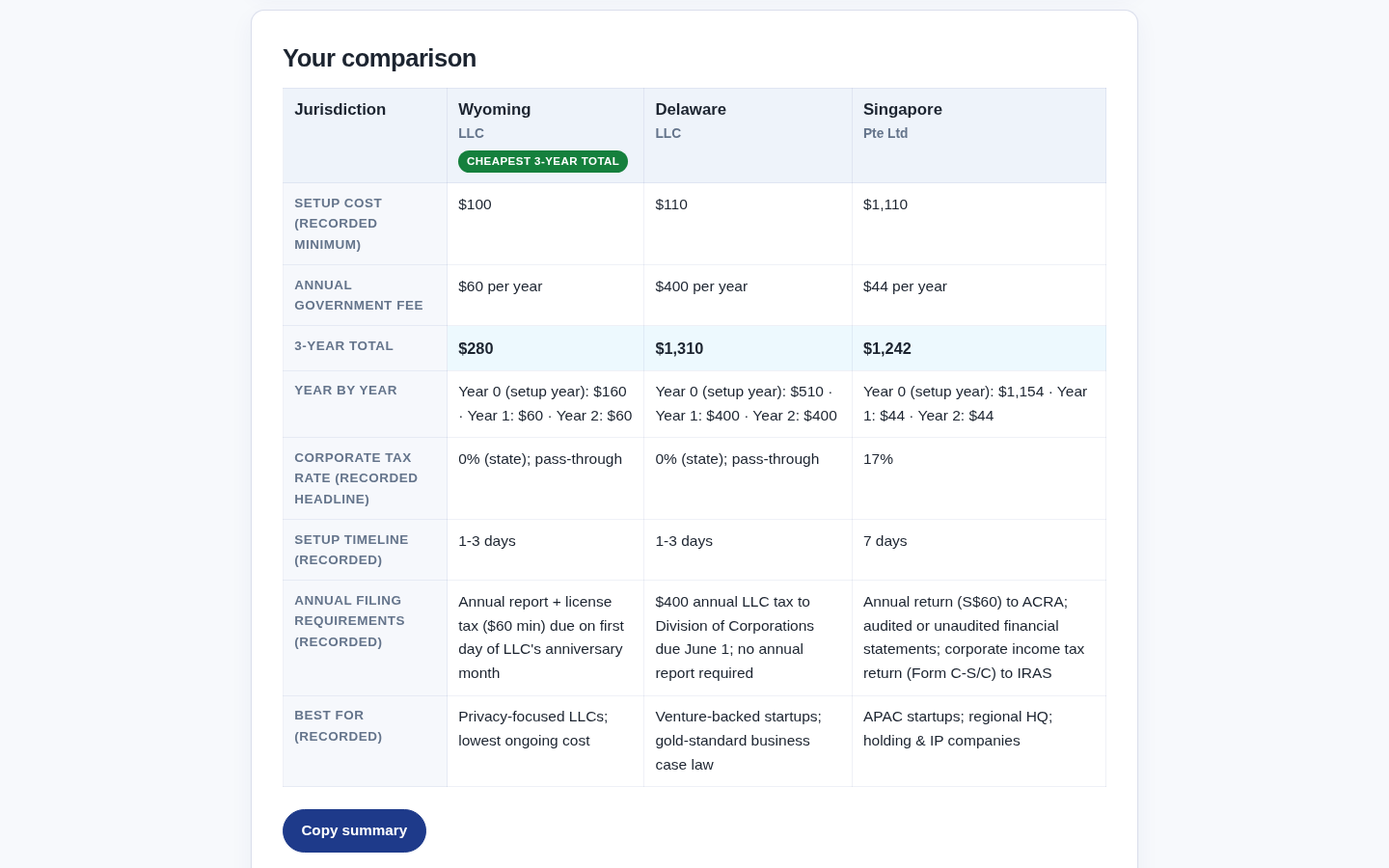
At the old $300 rate, Delaware's 3-year total was $1,010 and the gap to Wyoming was $730. At $400, the total is $1,310 and the gap is $1,030. Notice where the damage sits. Delaware's recorded setup cost of $110 is only $10 above Wyoming's $100, so formation was never the expensive part of a Delaware LLC. The annual tax is the expensive part: at $400 it runs more than six times Wyoming's recorded $60 annual license tax, and it repeats every year the company exists. New Mexico stays in a class of its own, with a $50 recorded setup and no annual government fee at all.
What did not change
Delaware's formation cost did not move. The Division of Corporations fee schedule for August 2026, the schedule our dataset records for Delaware, still lists the Certificate of Formation at $110. The reasons founders pick Delaware did not move either. The dataset records Delaware's best use as venture-backed startups and its gold-standard business case law, the Court of Chancery and the depth of precedent behind it, and it records no public register of owners. Wyoming still pairs its $60 minimum annual license tax with an annual report, and New Mexico still requires no annual report and charges no annual fee, though it does require a registered agent with a physical New Mexico address. Our Delaware vs Wyoming vs Nevada LLC comparison works through those non-cost differences in full. If Delaware was the right answer for your company at $300 a year, the honest question is whether $100 more changes the answer, not whether Wyoming became a different state in May.
Why Delaware can raise this tax
Entity fees are not a side income for Delaware. State financial reports put the state's corporate franchise taxes and related Division of Corporations fees at roughly 25 to 30 percent of General Fund revenue, about $1.8 to $1.9 billion a year in recent fiscal years, collected from a register of more than two million entities, most of them owned by people who do not live in Delaware. A flat $100 increase across every LLC, limited partnership and partnership is one of the few levers that raises real money without touching residents' income tax, and Delaware has no general sales tax to adjust instead. It is also why other states read Delaware's fee schedule so closely: the market leader just published its new price.
Deciding now: the dates that matter
If you form a Delaware LLC at any point in 2026, tax year 2026 is yours at $400, payable by June 1, 2027. Forming on December 31 instead of December 1 saves nothing. Waiting until January 2027 changes the result, but only by skipping a tax year outright: a company that does not exist in 2026 owes no 2026 tax, and its first payment, for tax year 2027 at the same $400 rate, falls due on June 1, 2028. If you already run a Delaware LLC, put June 1, 2027 in the calendar now, because a late payment adds a $200 penalty plus interest of 1.5 percent per month.
Then test your actual shortlist instead of a headline. The Jurisdiction Match Quiz applies your hard rules first, privacy, budget and local director, across all 50 recorded jurisdictions, and the Total Cost Calculator puts setup, annual fee and the 3-year total side by side. Two free runs a day on each is enough to test your real profile and one alternative. Our offshore formation cost analysis runs the same carrying-cost logic out to year five for the offshore set.
Method and sources
Law: House Bill 400, Chapter 273 of the Laws of Delaware, Volume 85, approved May 21, 2026, Sections 9, 16, 23 and 45; 6 Del. C. § 18-1107; Delaware Division of Corporations fee schedule, August 2026. Budget share: Delaware state financial reports, as reported by Delaware Live and Spotlight Delaware. Costs: the IncorporateCompare jurisdiction dataset, 50 jurisdictions verified September 13, 2026, with 3-year totals computed as recorded setup cost plus three times the recorded annual government fee. Two older posts on this site still print the superseded $300 Delaware tax in their cost tables; the figures in this article are the current ones. This article is general information about published fees and one statute, not legal or tax advice for your situation.