
Founders compare tax rates for weeks and spend zero minutes on banking. Then the offshore company formation is complete, the certificate is framed, and the company cannot receive money. The registry is the easy part of offshore company formation. The bank account is where it succeeds or fails, and difficulty is not evenly spread.
How banking difficulty actually distributes
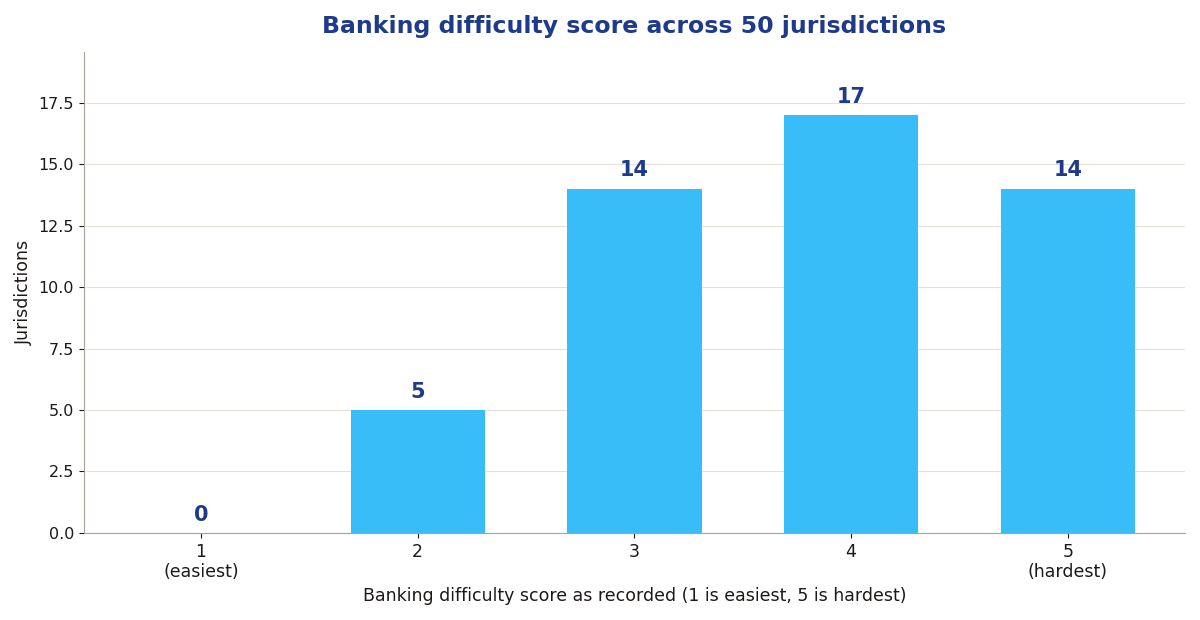
Source: IncorporateCompare jurisdiction database, 50 jurisdictions, Sep 13, 2026 snapshot; banking difficulty score as recorded, 1 (easiest) to 5 (hardest).
Not one of the 50 jurisdictions in the database scores 1, the easiest mark. Five score 2. Fourteen score 3, seventeen score 4, and fourteen score the maximum 5. In other words, 31 of the 50 jurisdictions sit at the hard end of the scale. That shape should change how you shop: the default assumption for a cross-border company is that banking will be a project, and the jurisdictions where it is not are the exception worth paying attention to.
The five jurisdictions that score 2 are Puerto Rico and the four US LLC states in the database: Delaware, Wyoming, Nevada and New Mexico. That matches what founders report anecdotally: a US LLC with a US fintech account is the path of least resistance in world banking right now. The score 3 band holds the mainstream financial centres, including the United Kingdom, Ireland, Singapore, Hong Kong, New Zealand and Canada: real banks, real KYC, but a well-worn path. Scores 4 and 5 hold most of the classic offshore names, where the account application is a negotiation involving minimum balances, source-of-funds evidence and patience. None of this is a secret; it is just rarely printed next to the tax rate, which is exactly where founders need it.

The ranking founders learn the hard way
- US LLC: easy. Mercury opens business accounts remotely for founders worldwide, free, in days. Relay and Wise work too.
- UK Ltd: moderate. Fintech accounts (Wise, Airwallex) are quick; high-street banks want UK directors.
- Singapore: moderate to hard. Corporate accounts often need a local director and sometimes an in-person visit.
- Estonia: moderate. EU fintech accounts work, but traditional Estonian banks are picky with e-residents.
- UAE free zone: hard. Budget 2 to 4 weeks, attested documents, and often a personal visit.
- BVI and Cayman: hard. High minimum balances, deep KYC, and banks that move slowly.
Read that ranking against the chart and the pattern is clear: the famous low-tax names cluster at scores 4 and 5, while the places with genuinely easy remote banking are a short list. A low tax rate on a company that cannot invoice is worth nothing.
What a score of 4 or 5 means in practice: attested and apostilled documents, proof of source of funds, a business plan the bank actually reads, minimum balances that can run into five figures, and timelines measured in weeks when everything goes well. The UAE entry in the ranking above budgets 2 to 4 weeks with a possible personal visit; the island jurisdictions can take longer, and some banks simply decline whole jurisdictions at the door. The workaround founders use is sequencing: form where banking is a 2 or a 3, build trading history and statements, and only then, if you still need it, approach the harder jurisdiction with evidence in hand. Banks price risk they cannot see; a year of clean statements makes you visible.
What to do with this
The rule: confirm your banking path BEFORE you incorporate. A company without a bank account is a liability with letterhead. When you compare jurisdictions on this site, the Jurisdiction Match Quiz treats banking as one of its six questions for exactly this reason, and the jurisdiction pages show the difficulty score next to the tax rate, where it belongs. If a jurisdiction scores 4 or 5, plan the bank application, the documents and the timeline as part of the formation budget, not as an afterthought.
Bank account opening difficulty decides whether the cheapest registration was worth it. Treat the score as a budget line, not a footnote: the harder the banking, the more time, documentation and minimum balance the formation really costs, whatever the registry charged you.