
There is no best jurisdiction for a startup in the abstract. There is only the jurisdiction that fits your banking, your customers, your investors and your tax residence, and founders keep picking one by copying someone else's answer. The mistakes below are the ones we see repeated, and the first one starts with a single number: the headline tax rate.
Start with the tax spread, not a tax rate
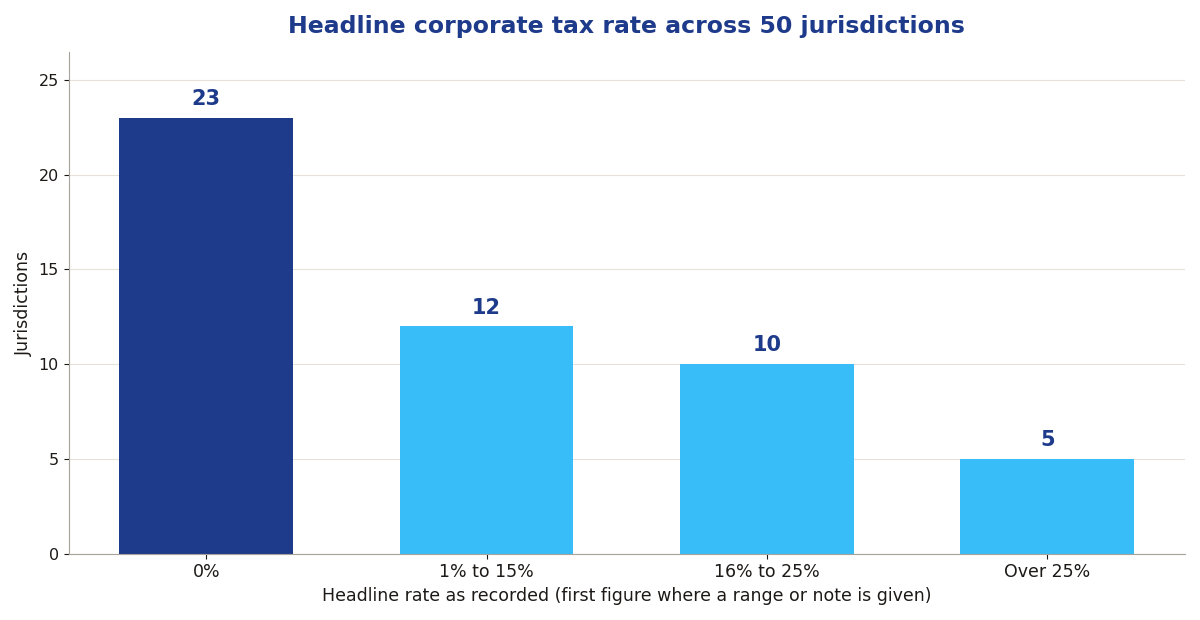
Source: IncorporateCompare jurisdiction database, 50 jurisdictions, Sep 13, 2026 snapshot; headline corporate tax rate as recorded, taking the first figure where the record gives a range or a note.
Of the 50 jurisdictions in the database, 23 record a headline corporate tax rate of 0 percent, including four US states whose LLCs are recorded at 0 percent state level because they are pass-throughs. Twelve sit between 1 and 15 percent, ten between 16 and 25 percent, and five go above 25 percent, up to 35 percent. Treat every one of those numbers as a headline, not a bill. The notes field is where the real rate lives: Singapore's 17 percent, for example, comes with a startup exemption of 75 percent on the first S$100k and 50 percent on the next S$100k for qualifying new companies. Reading the headline without the notes is mistake zero, and it feeds all seven below.
The bands have names worth knowing. Above 25 percent you will find Malta at 35 percent, New Zealand at 28, Chile at 27, Canada at about 26.5 and the Netherlands at 25.8. Just above zero sit Labuan at 3 percent, Puerto Rico at 4, the UAE at 9 and Ireland at 12.5. And the zero band mixes three very different things: island jurisdictions with no corporate tax at all, crown dependencies like the Isle of Man, Jersey and Guernsey, and four US states whose LLCs are pass-throughs, where the company pays no state-level tax because the owners pay personally. Same headline, three different machines. Which machine you are buying is the first thing to establish, before any of the seven mistakes below get a chance to happen.
The seven mistakes
1. Picking Delaware by default. If no VC will ever touch your cap table, you just bought a $300-a-year habit for nothing.
2. Ignoring annual fees. Wyoming's $60 versus Delaware's $300 is $1,200 over five years. New Mexico charges $0.

3. Forgetting banking. A BVI company with no bank account is an expensive PDF. US LLCs open Mercury accounts remotely in days.
4. Ignoring substance rules. Zero-tax jurisdictions now demand real offices and staff. The tax saving evaporates.
5. Confusing company tax with personal tax. Your Wyoming LLC does not shield you from tax where YOU live.
6. Ignoring VAT and GST. An Estonian company triggers EU VAT obligations from day one.
7. Choosing on formation price alone. Formation is the cheapest part. Year-two accounting is where budgets die.
The order to decide in
Pick the jurisdiction after the bank account question is answered, not before. If you want the sequence run for you, the Jurisdiction Match Quiz works through tax, privacy, banking, budget, directors and speed in that spirit, and the Total Cost Calculator shows what your shortlist costs over three years, annual fees included. IncorpTrack runs the whole formation sequence, filing plus EIN plus banking help, for $49 plus the state fee.
Run the sequence in the order the mistakes suggest. First banking: can this jurisdiction's companies actually open an account remotely, and at what difficulty? Second, the recurring cost: the annual government fee, every year, not the launch price. Third, the tax notes, not the tax headline, read against where you personally live. Fourth, substance: what presence does the jurisdiction now demand in exchange for its rate? A jurisdiction that survives all four questions is rarely the one with the biggest zero in the brochure, and it is almost always the one founders are still happy with in year three.
Every jurisdiction page on this site puts the four answers side by side: the headline rate with its notes, the banking difficulty score, the annual government fee and the setup timeline, all drawn from the same database the charts above use. Founders who compare on one number are guessing. Founders who compare on four are choosing.
Mistake number one is chasing the cheapest country to register a company without checking banking and substance rules first.